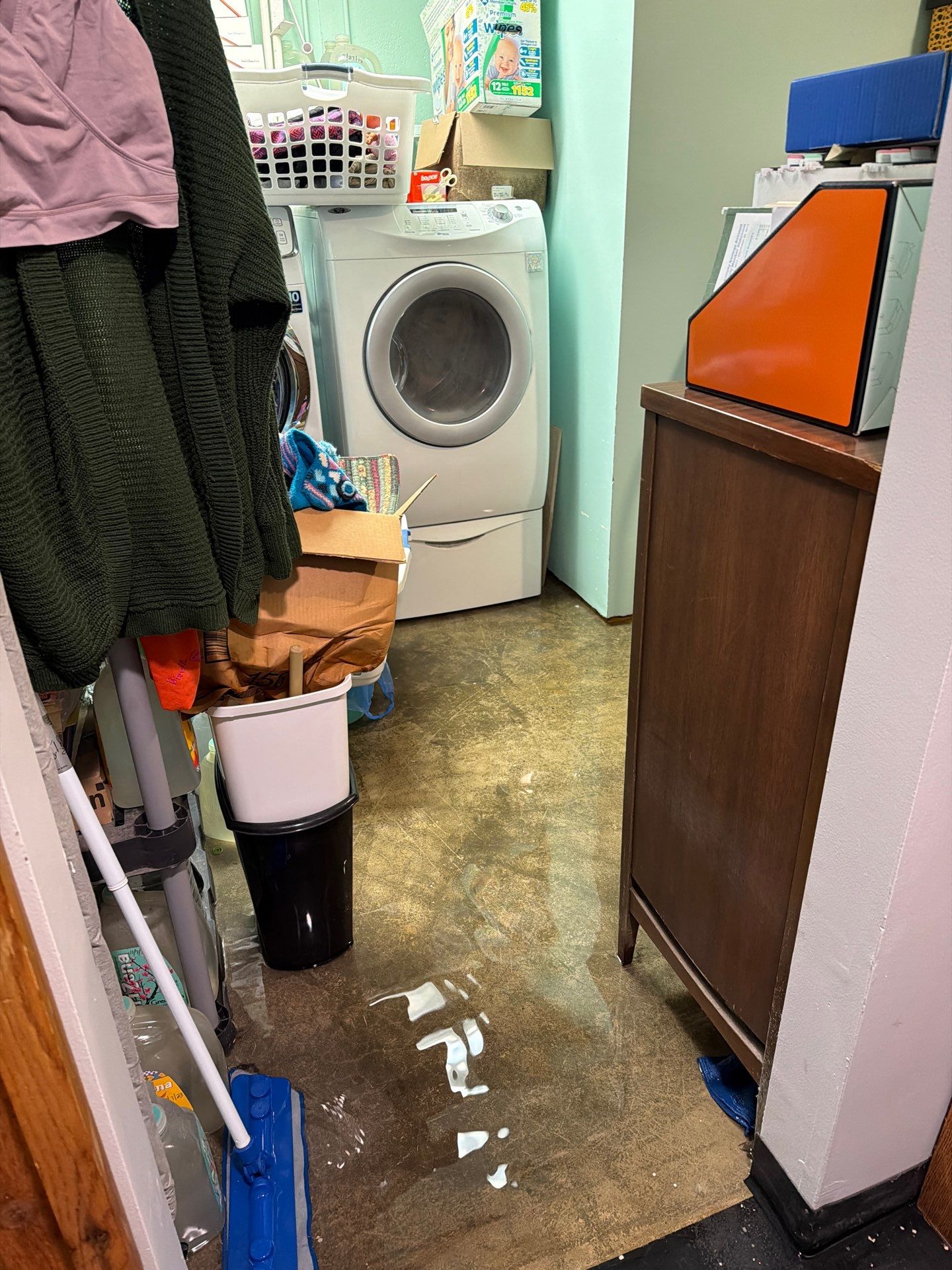
The Finished Basement That Looked Dry on Top
One Limestone Springs homeowner called us on a Sunday night, six days after a supply line under the kitchen sink had let go for what he estimated was four hours. He had run two box fans, pulled up the area rug, and figured the laminate floor in the basement below was fine because the surface was dry. When our technician arrived, the moisture meter told a different story. The subfloor under the laminate was reading 28 percent moisture content. Anything over 16 percent in wood is considered wet. The pad under the carpet on the basement stairs was holding water like a sponge.
Here is the part most homeowners miss. Water follows gravity and capillary action, not your sightline. By the time our crew set up containment and pulled the laminate, the bottom plates of two walls were saturated, and the insulation behind the drywall had wicked moisture up about 14 inches. Had he called within the first 24 hours, we likely would have dried in place using injection drying and air movers. Instead, we had to remove roughly 60 linear feet of drywall and treat the framing. The repair bill more than tripled.
His insurance adjuster later told him the claim would have been approved either way, but the delayed call meant a much larger scope of work and a deductible that suddenly felt less worth the savings. That is the quiet cost of waiting. The water does not stop moving just because the visible surface looks calm.
The Toilet Overflow That Was Not Just Water
A young family in a Delaware Crossing ranch had a toddler flush a bath toy. The toilet overflowed for maybe ninety seconds before dad got the supply valve closed. He toweled it up, sprayed some bathroom cleaner, and called it done. Three days later his wife noticed the hallway carpet felt cool and slightly tacky near the bathroom doorway. That is when they called us.
What they did not realize is that toilet overflow water, even from the bowl side, is treated as Category 2 or Category 3 water depending on the source. Bath toy or not, that water carried bacteria into the carpet pad, under the threshold, and into the subfloor. Bleach spray on the tile did nothing for what soaked underneath. Our crew had to remove the affected carpet and pad, apply an antimicrobial, and dry the subfloor before any reinstall could happen. Towels and a mop cannot sanitize a Category 2 loss. The IICRC standard exists because porous materials hold contamination that a homeowner cannot see or smell until mold sets in.
When DIY Is Actually Reasonable
We are not going to tell you every spill needs a crew. A clean water leak from a refrigerator line that you caught immediately, dried within 2 hours, and that only touched sealed tile? You are probably fine. A small drip from a window during a storm that wet a six inch patch of carpet? Towel it, fan it, monitor it for two days. If the area still feels cool or smells musty after 48 hours, call. Limestone Springs Water Restoration offers free water damage inspections across Limestone Springs, and if we cannot help, we will tell you directly. That is not a sales line. It is how we built an A+ BBB rating and kept our IICRC certification current.
The Burst Pipe Where the Fans Made It Worse
In February we took a call from a Limestone Springs couple whose upstairs bathroom supply line had split during a cold snap. They were proud of how fast they reacted. within 2 hours they had shut the water off, pulled wet towels out of the ceiling cavity below, and pointed every fan in the house at the wet drywall. When we showed up the next morning, the humidity in the affected rooms was sitting near 80 percent. They had moved water vapor from the wet materials into the air, then trapped it in the rest of the house, where it was now condensing on cold windows and inside wall cavities in rooms that had not even been part of the original leak.
Professional drying is not just fans. It is a calculated balance of air movement, dehumidification, and temperature, with daily moisture readings to confirm progress. Our crew brought in two LGR dehumidifiers, repositioned the air movers, and dropped the relative humidity to around 40 percent within twelve hours. According to the IICRC S500 standard, most structures should dry within three to five days when handled correctly. Theirs took four. Without the dehumidifiers, they were on track for secondary damage in rooms that had never been wet to begin with.
The Slow Dishwasher Leak Behind the Cabinets
Another call last spring came from a Limestone Springs retiree who noticed the toe kick under her dishwasher was slightly warped. She assumed it was an old install issue and ignored it for about two months. When she finally pulled the dishwasher out to clean behind it, the back of the cabinet box was black with mold and the subfloor had soft spots she could press with a thumb. A pinhole leak in the supply line had been releasing maybe a tablespoon of water per cycle, which is nothing you would ever see, but enough to keep the cavity behind the cabinet permanently damp.
Our crew dispatched within 2 hours of her call. We removed the lower cabinet run, cut out roughly nine square feet of subfloor, and performed targeted mold remediation before the rebuild. The lesson here is that not every water loss announces itself with a flood. Slow leaks are sometimes more expensive than fast ones because the damage compounds in silence. If something looks warped, smells off, or feels soft, trust that instinct and get a meter on it.
What DIY Cannot Replicate
After running thousands of jobs since 2018, we have a short list of what a homeowner with store bought equipment simply cannot do:
- Read moisture inside walls, subfloors, and framing without cutting holes
- Calculate the dehumidification load for the affected square footage
- Document the loss in the format insurance carriers require for a claim
- Apply EPA-registered antimicrobials approved for Category 2 and 3 water
- Verify dry standard with daily readings instead of guessing by feel
That last point is the one that costs people the most. Drywall can feel dry to the touch at 22 percent moisture content. Mold begins colonizing within 24 to 48 hours on wet organic material. By the time you smell it, you are already paying for remediation instead of mitigation.